3. Product overview#
The Geolux AX500 (powered by SmartSense) is a rugged air quality sensor designed for precise detection and measurement of five key atmospheric gases (NO, NO2, CO, SO2, O3) and particulate matter concentrations (PM1, PM2.5, PM10).
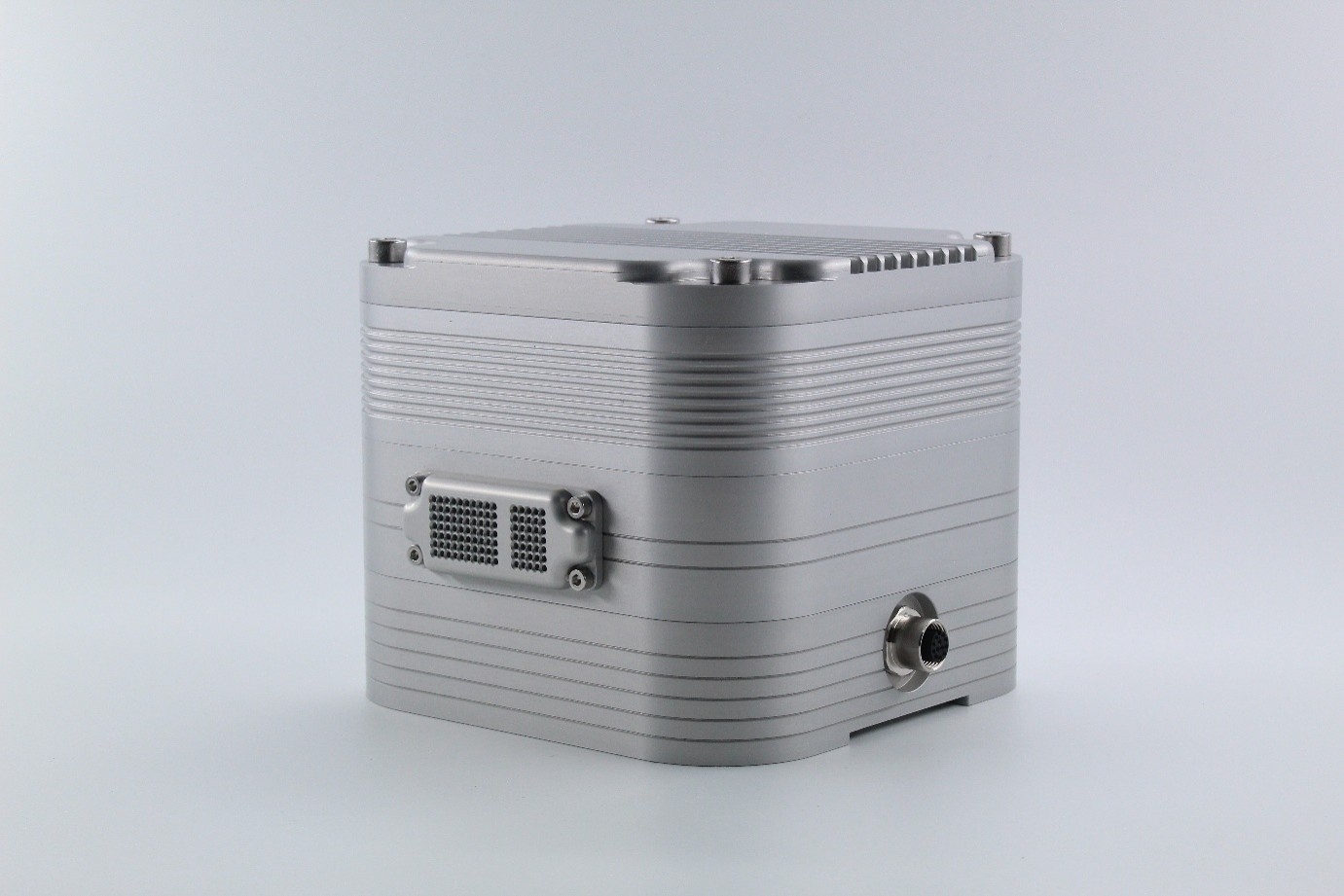
Figure 2. AX500 Air Quality Sensor#
The sensor delivers high measurement accuracy and strong data correlation. It is engineered for reliable operation in extremely demanding conditions, such as environments with elevated dust levels or frequent sandstorms. The AX500 features an automatic cleaning system, utilizing an integrated air compressor and compressed air tank to purge accumulated particles from the sensing elements.
This ensures consistent performance and sustained measurement accuracy. The sensor’s electronic architecture is optimized for low-power operation, enabling periodic measurements rather than continuous monitoring. The device can quickly initialize after power-up and begin providing data without delay.
A robust aluminium enclosure with integrated solar radiation shielding enables stable operation in hot climates without compromising measurement precision. The AX500 supports multiple communication interfaces, including Modbus, SDI-12, and RS-232, ensuring seamless integration with a wide range of standard data loggers and monitoring systems.
Table 1. AX500 specification
Model Name |
AX500 |
Gas Detection |
NO, NO2, CO, SO2, O3 |
Particulate Matter Detection |
PM1, PM2.5, PM10 |
Sensor Self Cleaning |
Air pressure cleaning through air compressor with 0.2 liter compressed air tank |
Section |
Parameter |
Value |
Unit |
|---|---|---|---|
NO Sensor Parameters |
Range |
0-3000 |
ppb |
Resolution |
1 |
ppb |
|
Precision¹ |
5 |
ppb |
|
Correlation coeff.² |
> 0.85 |
||
NO2 Sensor Parameters |
Range |
0-6500 |
ppb |
Resolution |
1 |
ppb |
|
Precision¹ |
6 |
ppb |
|
Correlation coeff.² |
> 0.80 |
||
CO Sensor Parameters |
Range |
0-10000 |
ppb |
Resolution |
1 |
ppb |
|
Precision¹ |
30 |
ppb |
|
Correlation coeff.² |
> 0.80 |
||
SO2 Sensor Parameters |
Range |
0-5000 |
ppb |
Resolution |
1 |
ppb |
|
Precision¹ |
6 |
ppb |
|
Correlation coeff.² |
> 0.80 |
||
O3 Sensor Parameters |
Range |
0-6000 |
ppb |
Resolution |
1 |
ppb |
|
Precision¹ |
6 |
ppb |
|
Correlation coeff.² |
> 0.85 |
||
PM1 Sensor Parameters |
Range |
0-1000 |
µg/m³ |
Resolution |
0.1 |
µg/m³ |
|
Precision¹ |
3 |
µg/m³ |
|
Correlation coeff.² |
> 0.85 |
||
PM2.5 Sensor Parameters |
Range |
0-1000 |
µg/m³ |
Resolution |
0.1 |
µg/m³ |
|
Precision¹ |
2 |
µg/m³ |
|
Correlation coeff.² |
> 0.85 |
||
PM10 Sensor Parameters |
Range |
0-3000 |
µg/m³ |
Resolution |
0.1 |
µg/m³ |
|
Precision¹ |
3 |
µg/m³ |
|
Correlation coeff.² |
> 0.80 |
1.Precision is measured as typical mean absolute difference from average reading of the collocated group of calibrated Sensees meters under same test conditions based on 1 hour averages. Values may differ depending on test conditions.
2.Correlation coefficient represents typical R2 of the calibrated sensor against reference instrument in the field test under different environmental conditions based on 1 hour averages. Values may differ depending on test conditions.
Operating Principle#
The AX500 includes two different measurement modules:
Gas measurement module
Particle measurement module
The following sections describe in detail the operating principles used in the particle and gas measurement modules. The performance and reliability of the temperature and humidity sensor are also important, as temperature and humidity affect pollutant measurements.
Humidity levels and changes in humidity can have a significant effect on measurement results. Therefore, it is important not only to measure humidity, but also to assess and compensate for its effect on the results. Temperature and humidity (option) are measured using a temperature and humidity probe, which is integrated into the AX500 to ensure the required reliability and performance.
Gas Measurement via Amperometric Sensors#
Amperometric electrochemical technology represents the most established method for sensing ambient pollutant gases in compact air quality monitors such as the AX500. These sensors operate as miniature galvanic cells where target gases trigger a reduction or oxidation reaction at a specialized electrode surface. This chemical interaction produces an electrical current proportional to the gas concentration, which the internal system then converts into accurate pollutant data. While highly effective, these sensors face inherent operational challenges, primarily their sensitivity to fluctuations in ambient temperature and humidity, interference from non-target gases known as cross-sensitivity, and a naturally finite operational lifespan.
To address these factors, the AX500 integrates sophisticated signal processing algorithms that automatically compensate for environmental variables, supported by a rigorous product calibration process that ensures high data quality across diverse field conditions. Since electrochemical sensors are consumable components, they must be replaced once their chemical activity is exhausted. Although the typical service interval is approximately two years, actual longevity depends heavily on local operating conditions. To assist users in maintenance planning, the AX500 features a built-in health index parameter that signals when service is required, with a recommendation for action once the index falls below thirty percent. Maintenance can be efficiently managed either through professional Geolux factory service or by purchasing pre-calibrated sensor replacement kits designed for straightforward installation in the field.
Particle Measurement with Optical Particle Counter#
The AX500 is based on a laser particle counter (LPC) that measures individual particles. This single-particle measurement principle enables more reliable and accurate measurement than commonly used nephelometer technology, which does not measure particles larger than approximately 1 µm and assumes that the particle size distribution is known.
In the AX500, the scattered light intensity from individual particles is measured. These individual pulses define the size of each particle, while the number of pulses corresponds to the number of particles. Based on the number and size of the particles, an algorithm is applied to calculate particle mass concentrations in µg/m³ for different size fractions: PM1, PM2.5, and PM10. As with all optical methods, particle density must be assumed when calculating mass concentrations.
Due to the physics of the scattering process, the amount of scattered light becomes extremely small when the particle size falls below the wavelength of the light used for the measurement. This limits the minimum particle size that can be measured with compact optical particle sensors. For the AX500, this limit is currently 0.3 µm.
Another limitation is the presence of fog droplets within the measurable detection range of the laser particle counter.
Water uptake by particles under conditions of high relative humidity (RH) increases the optical diameter of measured particles, which enhances light scattering during measurement. This may result in high sensor readings, even though the dry mass of the particles remains unchanged. The AX500 uses an algorithm to compensate for the effects of hygroscopic growth,, mitigating its influence on the measurement results. This adjustment is performed to enable reporting of dry particle mass.
Table 2. Events flagged as invalid in the AX500 and recommended to be excluded from analysis
Situation |
Description |
|---|---|
24 hours after powering on after several days |
Gas readings are not marked as invalid |
Temperature inside the AX500 unit is too high |
Gas readings are not valid due to limitations inherent to the electrochemical gas sensor technology used in the product. The operating temperature range is limited, and sensor performance is known to degrade when the temperature exceeds the operating range. |
Fog may have an effect |
Particle readings are not valid due to the presence of fog droplets within the measurable detection range of the laser particle counter |